Strategic Mortgage Advice

Jamie Ushko | Mortgage Broker

GET STARTED

Take control of your financial future with our process

Getting to know you

Discovery Call where I will take the time to understand your needs.

Build your mortgage plan

Create a comprehensive plan for your mortgage and a lender comparison report.

Sealed & Delivered

Sign the digital package and manage the final steps to complete your mortgage.

Future Planning

 Provide ongoing support and advice for the lifetime of your mortgage.

Getting to know you

Discovery Call where I will take the time to understand your needs.

Build your mortgage plan

Create a comprehensive plan for your mortgage and a lender comparison report.

Sealed & Delivered

Sign the digital package and manage the final steps to complete your mortgage.

Future Planning

 Provide ongoing support and advice for the lifetime of your mortgage.

Nice things people SAY about working with me

Specializing in the following areas

Go ahead and run some calculations.

Get started by completing my online mortgage application

APPLY NOW

I'll let you know exactly where you stand so you can proceed with confidence

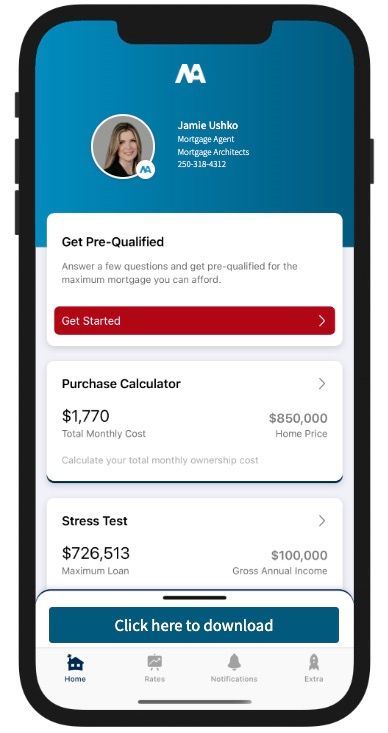
Download your mortgage Planning APP

Mortgage articles to keep you informed

By Jamie Ushko February 18, 2026
Alternative Lending in Canada: What It Is and When It Makes Sense Not everyone fits into the traditional lending box—and that’s where alternative mortgage lenders come in. Alternative lending refers to any mortgage solution that falls outside of the typical big bank offerings. These lenders are flexible, creative, and focused on helping Canadians who may not qualify for traditional financing still access the real estate market. Let’s explore when alternative lending might be the right fit for you. 1. You Have Damaged Credit Bad credit doesn’t have to mean your homeownership dreams are over. Many alternative lenders take a big-picture approach . While credit scores matter, they’ll also look at: Stable employment Consistent income Size of your down payment or existing equity If your credit has taken a hit but you can demonstrate strong income and savings—or have a solid explanation for past credit issues— an alternative lender may approve your mortgage when a bank won’t. Pro tip: Use an alternative mortgage as a short-term solution while you rebuild your credit, then refinance into a traditional mortgage with better terms down the line. 2. You're Self-Employed Being your own boss has its perks—but mortgage approval isn’t usually one of them. Traditional lenders require verifiable, consistent income—often two years’ worth. But self-employed Canadians typically write off significant expenses, reducing their declared income. Alternative lenders are more flexible and understanding of self-employed income structures. If your business is profitable and your personal finances are healthy, you may qualify even with lower stated income. Even if interest rates are slightly higher, this option is often worth it—especially when balanced against tax planning and business deductions . 3. You Earn Non-Traditional Income Today’s income sources aren’t always conventional. If you earn through: Airbnb rentals Tips and gratuities Rideshare or delivery apps (like Uber or Uber Eats) Commissions or contracts You might face challenges with traditional lenders. Alternative lenders are often more willing to work with these non-standard income streams , especially if the rest of your mortgage application is strong. Some will consider a shorter income history or evaluate your average earnings in a more flexible way. 4. You Need Expanded Debt-Service Ratios Canada’s mortgage stress test has made it harder for many borrowers to qualify with big banks. Alternative lenders can offer more generous debt-service ratio limits —meaning you might be able to qualify for a larger mortgage or a more suitable home, especially in competitive markets. While traditional GDS/TDS limits typically sit at 35/42 or 39/44 (depending on your credit), some alternative lenders will go higher, especially if: You have a larger down payment Your loan-to-value ratio is lower Your overall financial profile is strong It’s not a free-for-all—but it’s more flexible than bank lending. So, Is Alternative Lending Right for You? Alternative lending is designed to offer solutions when life doesn’t fit the traditional mold . Whether you're rebuilding credit, running your own business, or earning income in new ways, this path could help you get into a home sooner—or keep your current one. And here’s the key: You can only access alternative lenders through the mortgage broker channel . Let’s Explore Your Options Not sure where you fit? That’s okay. Every mortgage story is unique—and I’m here to help you write yours. If you’re curious about alternative mortgage products, want a second opinion, or need help getting approved, let’s talk . I’d be happy to help you explore the best solution for your situation. Reach out anytime. It would be a pleasure to work with you.
By Jamie Ushko February 11, 2026
If you're a homeowner juggling multiple debts, you're not alone. Credit cards, car loans, lines of credit—it can feel like you’re paying out in every direction with no end in sight. But what if there was a smarter way to handle it? Good news: there is. And it starts with your home. Use the Equity You’ve Built to Lighten the Load Every mortgage payment you make, every bit your home appreciates—you're building equity. And that equity can be a powerful financial tool. Instead of letting high-interest debts drain your income, you can leverage your home’s equity to combine and simplify what you owe into one manageable, lower-interest payment. What Does That Look Like? This strategy is called debt consolidation , and there are a few ways to do it: Refinance your existing mortgage Access a Home Equity Line of Credit (HELOC) Take out a second mortgage Each option has its own pros and cons, and the right one depends on your situation. That’s where I come in—we’ll look at the numbers together and choose the best path forward. What Can You Consolidate? You can roll most types of consumer debt into your mortgage, including: Credit cards Personal loans Payday loans Car loans Unsecured lines of credit Student loans These types of debts often come with sky-high interest rates. When you consolidate them into a mortgage—secured by your home—you can typically access much lower rates, freeing up cash flow and reducing financial stress. Why This Works Debt consolidation through your mortgage offers: Lower interest rates (often significantly lower than credit cards or payday loans) One simple monthly payment Potential for faster repayment Improved cash flow And if your mortgage allows prepayment privileges—like lump-sum payments or increased monthly payments—those features can help you pay everything off even faster. Smart Strategy, Not Just a Quick Fix This isn’t just about lowering your monthly bills (although that’s a major perk). It’s about restructuring your finances in a way that’s sustainable, efficient, and empowering. Instead of feeling like you're constantly catching up, you can create a plan to move forward with confidence—and even start saving again. Here’s What the Process Looks Like: Review your current debts and cash flow Assess how much equity you’ve built in your home Explore consolidation options that fit your goals Create a personalized plan to streamline your payments and reduce overall costs Ready to Regain Control? If your debts are holding you back and you're ready to use the equity you've worked hard to build, let's talk. There’s no pressure—just a practical conversation about your options and how to move toward a more flexible, debt-free future. Reach out today. I’m here to help you make the most of what you already have.
By Jamie Ushko February 4, 2026
So, you’re thinking about buying a home. You’ve got Pinterest boards full of kitchen inspo, you’re casually scrolling listings at midnight, and your friends are talking about interest rates like they’re the weather. But before you dive headfirst into house hunting— wait . Let’s talk about what “ready” really means when it comes to one of the biggest purchases of your life. Because being ready to own a home is about way more than just having a down payment (although that’s part of it). Here are the real signs you're ready—or not quite yet—to take the plunge into homeownership: 1. You're Financially Stable (and Not Just on Payday) Homeownership isn’t a one-time cost. Sure, there’s the down payment, but don’t forget about: Closing costs Property taxes Maintenance & repairs Insurance Monthly mortgage payments If your budget is stretched thin every month or you don’t have an emergency fund, pressing pause might be smart. Owning a home can be more expensive than renting in the short term—and those unexpected costs will show up. 2. You’ve Got a Steady Income and Job Security Lenders like to see consistency. That doesn’t mean you need to be at the same job forever—but a reliable, documented income (ideally for at least 2 years) goes a long way in qualifying for a mortgage. Thinking of switching jobs or going self-employed? That might affect your eligibility, so timing is everything. 3. You Know Your Credit Score—and You’ve Worked On It Your credit score tells lenders how risky (or trustworthy) you are. A higher score opens more doors (literally), while a lower score may mean higher rates—or a declined application. Pro tip: Pull your credit report before applying. Fix errors, pay down balances, and avoid taking on new debt if you’re planning to buy soon. 4. You’re Ready to Stay Put (At Least for a Bit) Buying a home isn’t just a financial decision—it’s a lifestyle one. If you’re still figuring out your long-term plans, buying might not make sense just yet. Generally, staying in your home for at least 3–5 years helps balance the upfront costs and gives your investment time to grow. If you’re more of a “see where life takes me” person right now, that’s totally fine—renting can offer the flexibility you need. 5. You’re Not Just Buying Because Everyone Else Is This one’s big. You’re not behind. You’re not failing. And buying a home just because it seems like the “adult” thing to do is a fast way to end up with buyer’s remorse. Are you buying because it fits your goals? Because you’re ready to settle, invest in your future, and take care of a space that’s all yours? If the answer is yes—you’re in the right headspace. So… Are You Ready? If you’re nodding along to most of these, amazing! You might be more ready than you think. If you’re realizing there are a few things to get in order, that’s okay too. It’s way better to prepare well than to rush into something you're not ready for. Wherever you’re at, I’d love to help you take the next step—whether that’s getting pre-approved, making a plan, or just asking questions without pressure. Let’s make sure your homebuying journey starts strong. Connect anytime—I’m here when you’re ready.
By Jamie Ushko February 18, 2026
Alternative Lending in Canada: What It Is and When It Makes Sense Not everyone fits into the traditional lending box—and that’s where alternative mortgage lenders come in. Alternative lending refers to any mortgage solution that falls outside of the typical big bank offerings. These lenders are flexible, creative, and focused on helping Canadians who may not qualify for traditional financing still access the real estate market. Let’s explore when alternative lending might be the right fit for you. 1. You Have Damaged Credit Bad credit doesn’t have to mean your homeownership dreams are over. Many alternative lenders take a big-picture approach . While credit scores matter, they’ll also look at: Stable employment Consistent income Size of your down payment or existing equity If your credit has taken a hit but you can demonstrate strong income and savings—or have a solid explanation for past credit issues— an alternative lender may approve your mortgage when a bank won’t. Pro tip: Use an alternative mortgage as a short-term solution while you rebuild your credit, then refinance into a traditional mortgage with better terms down the line. 2. You're Self-Employed Being your own boss has its perks—but mortgage approval isn’t usually one of them. Traditional lenders require verifiable, consistent income—often two years’ worth. But self-employed Canadians typically write off significant expenses, reducing their declared income. Alternative lenders are more flexible and understanding of self-employed income structures. If your business is profitable and your personal finances are healthy, you may qualify even with lower stated income. Even if interest rates are slightly higher, this option is often worth it—especially when balanced against tax planning and business deductions . 3. You Earn Non-Traditional Income Today’s income sources aren’t always conventional. If you earn through: Airbnb rentals Tips and gratuities Rideshare or delivery apps (like Uber or Uber Eats) Commissions or contracts You might face challenges with traditional lenders. Alternative lenders are often more willing to work with these non-standard income streams , especially if the rest of your mortgage application is strong. Some will consider a shorter income history or evaluate your average earnings in a more flexible way. 4. You Need Expanded Debt-Service Ratios Canada’s mortgage stress test has made it harder for many borrowers to qualify with big banks. Alternative lenders can offer more generous debt-service ratio limits —meaning you might be able to qualify for a larger mortgage or a more suitable home, especially in competitive markets. While traditional GDS/TDS limits typically sit at 35/42 or 39/44 (depending on your credit), some alternative lenders will go higher, especially if: You have a larger down payment Your loan-to-value ratio is lower Your overall financial profile is strong It’s not a free-for-all—but it’s more flexible than bank lending. So, Is Alternative Lending Right for You? Alternative lending is designed to offer solutions when life doesn’t fit the traditional mold . Whether you're rebuilding credit, running your own business, or earning income in new ways, this path could help you get into a home sooner—or keep your current one. And here’s the key: You can only access alternative lenders through the mortgage broker channel . Let’s Explore Your Options Not sure where you fit? That’s okay. Every mortgage story is unique—and I’m here to help you write yours. If you’re curious about alternative mortgage products, want a second opinion, or need help getting approved, let’s talk . I’d be happy to help you explore the best solution for your situation. Reach out anytime. It would be a pleasure to work with you.
By Jamie Ushko February 11, 2026
If you're a homeowner juggling multiple debts, you're not alone. Credit cards, car loans, lines of credit—it can feel like you’re paying out in every direction with no end in sight. But what if there was a smarter way to handle it? Good news: there is. And it starts with your home. Use the Equity You’ve Built to Lighten the Load Every mortgage payment you make, every bit your home appreciates—you're building equity. And that equity can be a powerful financial tool. Instead of letting high-interest debts drain your income, you can leverage your home’s equity to combine and simplify what you owe into one manageable, lower-interest payment. What Does That Look Like? This strategy is called debt consolidation , and there are a few ways to do it: Refinance your existing mortgage Access a Home Equity Line of Credit (HELOC) Take out a second mortgage Each option has its own pros and cons, and the right one depends on your situation. That’s where I come in—we’ll look at the numbers together and choose the best path forward. What Can You Consolidate? You can roll most types of consumer debt into your mortgage, including: Credit cards Personal loans Payday loans Car loans Unsecured lines of credit Student loans These types of debts often come with sky-high interest rates. When you consolidate them into a mortgage—secured by your home—you can typically access much lower rates, freeing up cash flow and reducing financial stress. Why This Works Debt consolidation through your mortgage offers: Lower interest rates (often significantly lower than credit cards or payday loans) One simple monthly payment Potential for faster repayment Improved cash flow And if your mortgage allows prepayment privileges—like lump-sum payments or increased monthly payments—those features can help you pay everything off even faster. Smart Strategy, Not Just a Quick Fix This isn’t just about lowering your monthly bills (although that’s a major perk). It’s about restructuring your finances in a way that’s sustainable, efficient, and empowering. Instead of feeling like you're constantly catching up, you can create a plan to move forward with confidence—and even start saving again. Here’s What the Process Looks Like: Review your current debts and cash flow Assess how much equity you’ve built in your home Explore consolidation options that fit your goals Create a personalized plan to streamline your payments and reduce overall costs Ready to Regain Control? If your debts are holding you back and you're ready to use the equity you've worked hard to build, let's talk. There’s no pressure—just a practical conversation about your options and how to move toward a more flexible, debt-free future. Reach out today. I’m here to help you make the most of what you already have.
By Jamie Ushko February 4, 2026
So, you’re thinking about buying a home. You’ve got Pinterest boards full of kitchen inspo, you’re casually scrolling listings at midnight, and your friends are talking about interest rates like they’re the weather. But before you dive headfirst into house hunting— wait . Let’s talk about what “ready” really means when it comes to one of the biggest purchases of your life. Because being ready to own a home is about way more than just having a down payment (although that’s part of it). Here are the real signs you're ready—or not quite yet—to take the plunge into homeownership: 1. You're Financially Stable (and Not Just on Payday) Homeownership isn’t a one-time cost. Sure, there’s the down payment, but don’t forget about: Closing costs Property taxes Maintenance & repairs Insurance Monthly mortgage payments If your budget is stretched thin every month or you don’t have an emergency fund, pressing pause might be smart. Owning a home can be more expensive than renting in the short term—and those unexpected costs will show up. 2. You’ve Got a Steady Income and Job Security Lenders like to see consistency. That doesn’t mean you need to be at the same job forever—but a reliable, documented income (ideally for at least 2 years) goes a long way in qualifying for a mortgage. Thinking of switching jobs or going self-employed? That might affect your eligibility, so timing is everything. 3. You Know Your Credit Score—and You’ve Worked On It Your credit score tells lenders how risky (or trustworthy) you are. A higher score opens more doors (literally), while a lower score may mean higher rates—or a declined application. Pro tip: Pull your credit report before applying. Fix errors, pay down balances, and avoid taking on new debt if you’re planning to buy soon. 4. You’re Ready to Stay Put (At Least for a Bit) Buying a home isn’t just a financial decision—it’s a lifestyle one. If you’re still figuring out your long-term plans, buying might not make sense just yet. Generally, staying in your home for at least 3–5 years helps balance the upfront costs and gives your investment time to grow. If you’re more of a “see where life takes me” person right now, that’s totally fine—renting can offer the flexibility you need. 5. You’re Not Just Buying Because Everyone Else Is This one’s big. You’re not behind. You’re not failing. And buying a home just because it seems like the “adult” thing to do is a fast way to end up with buyer’s remorse. Are you buying because it fits your goals? Because you’re ready to settle, invest in your future, and take care of a space that’s all yours? If the answer is yes—you’re in the right headspace. So… Are You Ready? If you’re nodding along to most of these, amazing! You might be more ready than you think. If you’re realizing there are a few things to get in order, that’s okay too. It’s way better to prepare well than to rush into something you're not ready for. Wherever you’re at, I’d love to help you take the next step—whether that’s getting pre-approved, making a plan, or just asking questions without pressure. Let’s make sure your homebuying journey starts strong. Connect anytime—I’m here when you’re ready.

Go ahead and schedule a meeting with me
Covering the topics you need to become an expert in the Canadian Mortgage Industry

As an advocate for her industry, Jamie has created and produced the popular podcast "How to be a Mortgage Broker" with the goal of demystifying the startup process and helping other agents reach success quickly. This has been the perfect avenue to stay up-to-date with industry experts and branch out into new business opportunities. The best part is that all her subscribers get to follow along on the journey.